
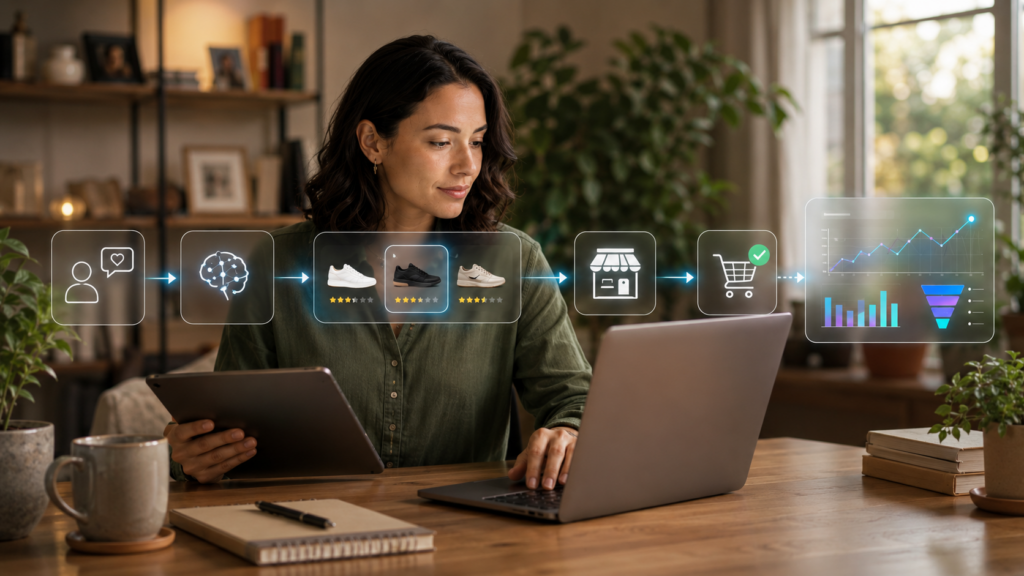
Performance commerce has a new timing problem: influence is forming before measurement can recognize it.
AI assistants, conversational search, universal carts, retail-media systems, and agent-readable content are moving demand creation upstream.
A shopper may be guided toward a brand, product, marketplace, or retailer page before a click, referral, visit, or conversion gives the reporting system something to count. By the time the measurable event appears, the system that shaped the decision may already be invisible.
That creates a commercial risk, not just a reporting inconvenience: budgets can be misallocated, partners can be undervalued, publishers can lose compensation, and leaders can make AI commerce investments without knowing which signals actually changed revenue outcomes.
The issue is whether companies can still prove contribution when influence happens earlier than attribution can see.
AI Commerce Attribution Is Becoming A Timing Problem
The shift is visible wherever AI systems now shape discovery, comparison, routing, and purchase intent before the first measurable performance signal appears.
Conversational AI recommendations are being studied for their ability to move consumers into same-name search, brand-site visits, and retailer-page visits. Retailers are building AI shopping assistants into marketplace and app experiences. Google is pushing commerce across search, video, email, Gemini, wallet, merchants, and cart infrastructure.
The common thread is not the interface; it is the earlier point at which commercial preference is being formed.
These systems can recommend, route, filter, and complete more of the journey before a traditional click, visit, referral, or conversion signal appears.
For example, an AI assistant may recommend a product category before branded search, a marketplace assistant may steer the shopper toward one retailer, or a universal cart may complete the transaction outside the brand’s preferred analytics path.
Agentic Commerce Makes Content Readiness A Performance Issue
Commerce content now has two audiences: people and agents.
Human shoppers still need useful product context, credible comparisons, reviews, pricing, availability, and reasons to buy. AI agents need structured, consistent, interpretable signals that can be retrieved, summarized, compared, and acted on.
If the content, catalog, offer, and product data layer is weak, the brand may lose visibility before a shopper ever sees a page, tile, ad, link, or marketplace result.
Content readiness is becoming a performance issue.
When agent-mediated systems decide what information is visible, which products are comparable, and which destinations are worth routing to, the old content model starts to look incomplete. The question is no longer only whether content ranks or converts.
The question is whether the systems shaping demand can understand it well enough to preserve visibility and route intent toward a place where purchase can happen.
A practical test for leaders is simple: can an agent identify the product, compare it accurately, understand the offer, verify availability, and route the shopper to a reliable purchase destination without losing the brand’s preferred context?
AI Search Attribution Is Becoming A Publisher Monetization Problem
AI search makes the proof problem more visible because the source of influence and the destination of monetization can separate.
Publisher and commerce content can still shape demand even when fewer users click through to the original source. AI summaries, answer engines, and conversational search interfaces can compress discovery into the response layer.
That may help consumers move faster, but it weakens the traditional signals that publishers, partners, and marketers use to prove contribution.
A source can influence the decision without receiving the click.
That is the commercial tension. Value may still be created, but the reporting trail disappears.
A publisher review, buying guide, or comparison page may help train or inform an answer that shapes demand, while the measurable visit, cart, or sale lands somewhere else entirely.
Commerce Media Measurement Must Prove Incrementality
Measurement now must do more than assign credit after the fact; it must estimate whether upstream exposure changed the outcome.
Regulators are beginning to pressure AI search platforms on publisher opt-outs, citations, and content use. Researchers are testing whether AI Overviews, AI Mode, and conversational recommendations change downstream traffic and engagement. Measurement teams are trying to rebuild proof through privacy-safe attribution, incrementality, and campaign-level modeling.
The distinction matters: attribution assigns credit, measurement estimates contribution, and monetization converts contribution into compensation, budget confidence, or partner value.
As influence becomes more distributed than the systems built to measure it, teams need incrementality tests, modeled contribution, and governance standards that can survive signal loss.
The New Proof Model: Visibility, Routing, Contribution
The next phase of performance commerce will reward teams that can prove three things better than their competitors: whether AI systems can see the brand, where AI-influenced demand is routed, and whether that exposure produces incremental commercial outcomes.
A useful proof model has three pillars.
Visibility asks whether AI assistants, answer engines, marketplaces, and retail-media systems can find, understand, compare, and recommend the brand’s products accurately.
Routing asks where AI-influenced intent goes: to a brand site, retailer page, marketplace listing, universal cart, publisher surface, or closed commerce environment.
Contribution asks whether upstream exposure changed downstream behavior in a measurable way, using incrementality testing, modeled lift, matched-market analysis, or other privacy-safe methods when deterministic attribution is incomplete.
Together, those pillars turn the question from “Which channel gets credit?” into “Which upstream signals created demand, where did that demand go, and what commercial value did it produce?” The strategic advantage is not simply adopting AI commerce; it is proving which AI-shaped moments create demand before they become visible as traffic, cart activity, or conversion.
The companies that move first will not be the ones that claim AI changed everything. They will be the ones that can prove which upstream signals changed commercial outcomes and which partners, platforms, and content systems deserve investment.
The Big So What
For CEOs
- Treat proof gaps as investment and revenue risk, not reporting noise.
- Ask which AI, marketplace, publisher, and retail-media surfaces are shaping demand before existing systems can see it.
- Require a cross-functional operating view of where influence is created, routed, and proven.
- Tie AI commerce funding to contribution proof, not only last-touch reported conversions.
For CMOs
- Build content for both human shoppers and AI-mediated discovery systems.
- Pressure-test whether product data, offers, reviews, and comparisons are agent-readable.
- Reframe discoverability around where recommendations form, not only where clicks arrive.
- Build a content and data readiness agenda that supports search, retail media, marketplaces, publishers, and agent-mediated discovery.
For CROs
- Audit where upstream influence disappears between recommendation, routing, cart, and conversion.
- Compare conversion reliability across brand sites, retailer pages, marketplaces, universal carts, and partner paths.
- Strengthen reporting around routed demand, pipeline quality, and incremental revenue, not just final-touch activity.
- Build proof standards that survive signal loss and compressed discovery.
References
Would You Let Robots Spend Your Money? Google Is Betting on It — The Verge
From Prompt to Purchase: How AI Brand Recommendations Move Consumers on the Open Web — arXiv
Shopping Reasoning Bench: An Expert-Authored Benchmark for Multi-Turn Conversational Shopping Assistants — arXiv
UK Orders Google to Allow Publishers to Opt Out of AI Scraping for Search Summaries — Associated Press
Companies That Can Serve Both Human and Agent Audiences Will Be the Ones That Survive — TechRadar