
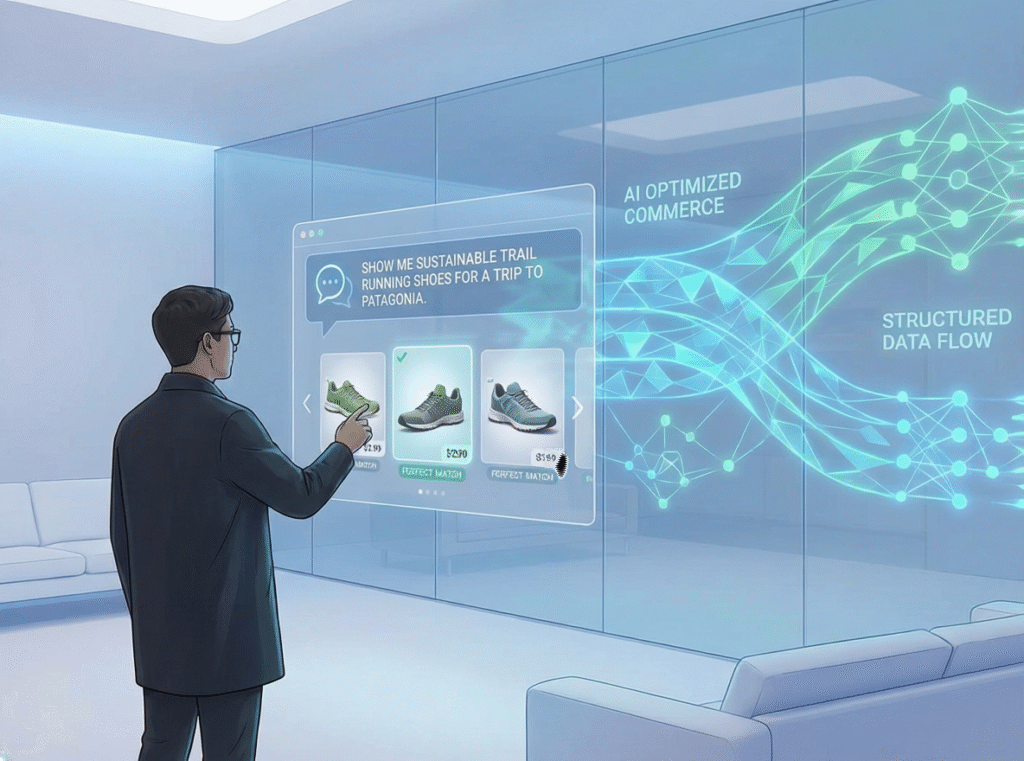
Answer engine commerce is changing how people find and choose products online. For the last decade, discovery meant keyword search, scrolling and clicking. But shopper behavior has shifted: people now ask full questions in natural language across chatbots, voice assistants, messaging apps, visual search experiences and publisher environments. They want guidance in the moment, not a grid of links.
That shift is why AI answer engines matter in commerce. These systems interpret intent and context, then return personalized recommendations instantly. When brands build for answer engines, they can show up earlier in the buying journey, influence decisions more naturally, and extend discovery beyond the search box into the channels where intent and commerce actually happens.
What Is Answer Engine Commerce?
Answer engine commerce is the strategy of using AI answer engines to drive product discovery and sales through conversational and multimodal recommendations across owned and partner channels.
Unlike traditional search engines that mainly match keywords, answer engines interpret meaning. They factor in a shopper’s preferences, constraints and implied needs to deliver best-fit products for that moment. The experience feels less like searching and more like assisted discovery: a shopper expresses what they need, receives tailored guidance, and the engine refines through conversation.
How AI Answer Engines Work in eCommerce
When a shopper asks, “What’s the best moisturizer for sensitive skin under $30?” an answer engine doesn’t just look for matching words. It reads intent: skin type, budget, desired outcome and likely constraints (like fragrance-free or dermatologist-tested). Then it draws from structured product data and content to recommend a short set of options that make sense for that specific shopper.
Because these engines learn from interaction outcomes, their accuracy improves over time. That feedback loop is why data readiness is non-negotiable: when product information is incomplete, inconsistent or unstructured, the engine can’t recommend confidently and the experience breaks.
Why Answer Engine Commerce Matters for Brands
Answer engine commerce isn’t just a UX upgrade. It changes where and how brands compete.
It moves influence earlier. Shoppers ask questions before they search marketplaces. Answer engines let brands engage at the first spark of intent, while preferences are forming, not after buyers are deep in comparison mode.
It reduces discovery friction. Instead of forcing shoppers to scroll and self-serve, answer engines narrow options quickly. Brands typically see stronger engagement, fewer abandoned sessions and clearer paths to conversion.
It reveals richer intent signals. You don’t just see that someone searched for “running shoes.” You see that they asked for “wide-fit running shoes for knee pain under $120,” compared two options, and bought the third. That context improves merchandising, content strategy and performance marketing.
Key Use Cases for Answer Engine Commerce
Answer engine commerce shows up wherever shoppers naturally ask for help, including:
- Assisted discovery on brand sites via shopping assistants that guide choices in natural language.
- PDPs that act like answer surfaces, resolving questions about fit, features, variants, price and availability where decisions happen.
- Voice commerce and assistants like Alexa and Google Assistant, where questions replace keyword searches.
- Visual and multimodal discovery combining image inputs, chat, shoppable video and AR.
- Publisher, affiliate and retail media environments where products surface inside intent-driven journeys.
- Post-purchase support and replenishment that helps shoppers set up, care for and reorder with less friction.
Answer Engine Commerce vs. Traditional Search Commerce
Answer engines extend discovery beyond the search box and create a different shopper experience.
Traditional search is self-serve: shoppers translate needs into keywords, sift results and compare manually. Personalization is often shallow and rule-based, attribution is last-click and the path to purchase is multi-step.
Answer engine commerce is intent-led: shoppers express needs naturally, the engine interprets context and recommendations adapt in real time. Personalization is dynamic, attribution is session-based and intent-rich, and discovery often resolves faster — sometimes without multiple clicks at all.
This isn’t just a better search bar. It’s a new discovery model.
How Brands Succeed with Answer Engines (and How Shopnomix Helps)
Winning with answer engines looks less like “ranking for keywords” and more like being the best answer in the places where shoppers already ask.
Brands that succeed do a few things consistently: they make product data reliable and machine-readable (complete attributes, clean taxonomy, accurate pricing and availability, schema aligned to standards). They invest in answer-ready content that mirrors how real shoppers ask questions, so guidance feels natural. And they treat answer engines as living channels, using performance signals to tune flows, fix data gaps and improve recommendation quality over time.
When internal technical or data bandwidth is limited, a partner can remove friction. Shopnomix helps brands activate answer engine commerce across multiple AI discovery environments without taking on integration and syndication complexity internally.
A quick clarification on roles: the answer-engine experience (chat/voice/visual interface) typically lives on the brand, platform or publisher side. Shopnomix powers the commerce layer inside those conversational journeys, ensuring products show up as relevant answers, and that brands can measure and optimize commercial outcomes.
Because answer engines depend on dependable structured data, Shopnomix partners with Affiliate.com to leverage a high-quality corpus covering billions of products and affiliate offers. Affiliate.com strengthens product and offer intelligence; Shopnomix connects that intelligence to answer-engine environments and optimizes performance.
In practice, Shopnomix helps with:
- Product feed syndication so structured data stays consistent and current.
- API integrations connecting catalogs to answer engines across chat, voice, visual and messaging placements.
- Campaign optimization and real-time reporting dashboards to track influence, conversions and incremental lift.
- Scalable activation across publisher and retail ecosystems, including native placements within AI discovery flows.
How to get started with Shopnomix
If you’re thinking, “Great, how do I actually do this with Shopnomix?,” here’s the straightforward path:
- Activate your Shopnomix account and catalog.
We align on your goals, priority categories and target environments. - Connect and normalize product data (powered by Affiliate.com).
We ensure your product and offer information is complete, consistent and answer-engine-ready. - Syndicate feeds + integrate APIs into answer-engine environments.
This includes brand assistants, publisher partners, voice/visual surfaces and other AI discovery placements where shoppers ask for help. - Launch and optimize performance in real time.
We track conversational engagement, recommendation clicks, add-to-carts, purchases influenced and incremental lift, and then tune data and flows to improve outcomes.
If you’re already a Shopnomix client, this is an expansion of your current activation: we plug your product catalog into emerging AI discovery channels and run them as measurable performance surfaces.
The goal is simple: help brands show up as the most relevant answer, wherever discovery happens.
Challenges, Limitations and Readiness for Answer Engine Commerce
Answer engine commerce delivers big upside, but only when the foundation is sound.
Data quality is the most common risk. If product attributes are missing, inconsistent or out of date, answer engines can’t recommend confidently and the shopper experience suffers. Weak answers don’t just reduce conversion; they can erode trust in the brand.
Experience quality matters, too. Discovery falls flat if guidance feels scripted, robotic, or out of sync with how shoppers naturally ask for help. Brands need to tune tone and flows, so interactions feel genuinely useful.
Privacy and transparency are essential. Shoppers expect responsible data handling, and regulators increasingly demand it. Brands should be clear about how data is used, ensure compliance across channels and avoid personalization that feels intrusive.
Not every brand should scale immediately. Highly regulated categories, weak structured-data foundations, or products requiring in-person consultation may need a narrower start. Pilot with a focused use case, learn quickly, and expand once experience and measurement are reliable.
Measuring Success in Answer Engine Commerce
Because answer engines influence decisions earlier, measurement needs to go beyond last-click. The most useful view blends discovery quality with revenue impact.
Track conversation engagement, recommendation clicks, add-to-carts and purchases influenced by AI flows, and watch zero-click resolution, where needs are met in-session. Just as valuable are the intent insights in what shoppers ask: recurring questions, hesitation points and content or attribute gaps.
Answer engine commerce doesn’t just show what sold. It shows why it sold.
Emerging Trends in AI Answer Engines for Shopping
Answer engines are rapidly evolving into multimodal discovery. Shoppers will increasingly ask by speaking, typing, scanning or showing images, and engines will interpret each input inside a single coherent journey.
Retail media is also becoming native inside these experiences. Sponsored placements won’t feel like interruptions; they’ll appear as relevant parts of the answer. Over time, answer engine commerce will feel less like a new channel and more like the default interface for digital shopping.
The Net Gain
Answer engine commerce isn’t just a nicer interface. It changes where and how brands compete. Shoppers ask questions earlier than they search, so answer engines let brands show up at the first spark of intent, before buyers default to marketplaces or get stuck comparing endless options. That earlier influence helps brands shape preference while decisions are still forming.
For brands looking to scale across emerging answer-engine channels, Shopnomix enables rapid activation of product placements across multiple publishers and AI discovery environments, backed by real-time analytics and flexible campaign optimization to measure true impact and drive results.