
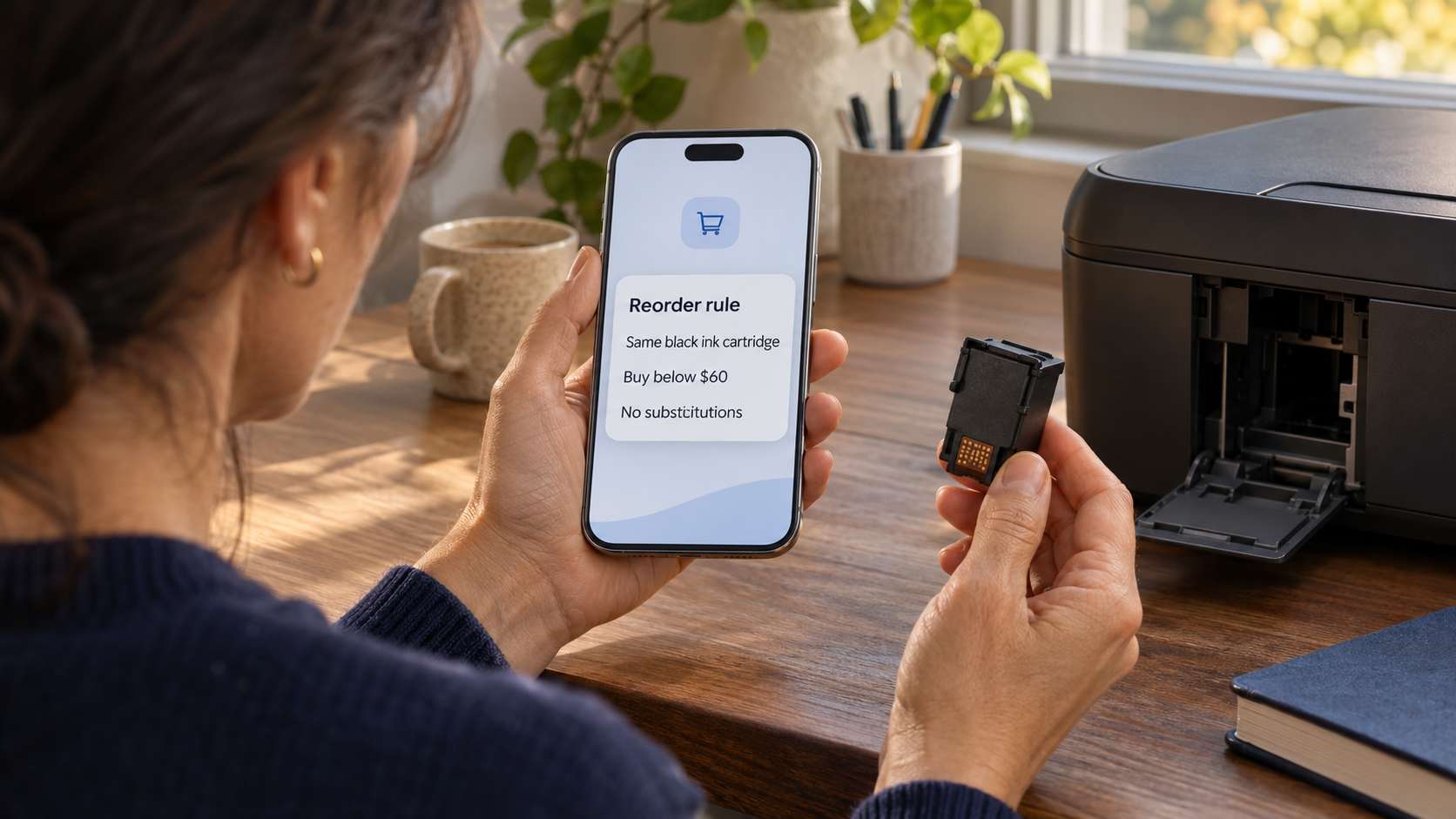
Say you sell printer cartridges. A shopper asks an AI assistant to show compatible options under $60. Your brand may be one of the options. Now suppose the shopper tells the same assistant to reorder the cartridges they already use when the price drops below $60. Does showing up in the first conversation help you win the second order?
Brands can control the product information they supply and choose where to advertise. Publishers can control what they recommend in their own coverage. Both can influence what shoppers consider. In somebody else’s assistant, the platform decides which offers can appear and where ads are allowed. The shopper chooses from those offers or gives the assistant instructions to buy.
Before you spend, find out which part of the process you’re paying to influence.
What a Brand Can Control
A cartridge brand can make sure its product details, compatibility, price, and stock are correct. It can also work with retail partners to make the right cartridge available through the stores and checkout routes an assistant can use. One makes the offer understandable. The other makes it possible to buy. Neither guarantees where the product will rank.
A brand can give shoppers a reason to ask for it by name. Show which printers the cartridge fits and how to install it. Get the product in front of reviewers who can compare it on their own terms. That work can influence what shoppers ask for and give an assistant more useful material to draw on, without guaranteeing it will use a particular source.
A brand can also answer questions directly.
VentureBeat reported in November that eligible businesses can offer a branded assistant inside ChatGPT to answer questions about their products and policies. A shopper who opens that conversation could ask whether a cartridge fits an older printer. That gives the brand a way to help a shopper who seeks it out. It doesn’t give the brand control over GPT’s general recommendations.
Paid placement is another option where the platform offers it.
Digiday reported that a Sponsored Product could appear among the options Amazon’s text shopping assistant sent to a shopper. Those placements were free to advertisers at the time of reporting. The report shows where a sponsored item can appear. It doesn’t establish which audiences advertisers can target in those replies or how often their products will be shown.
Amazon draws a line at orders its assistant makes automatically. Those purchases stay ad-free under the approach Digiday described. If a shopper has already told it to reorder a specific cartridge at a certain price, that sponsored placement won’t change the order. Ask each platform where its ads can appear and where they stop.
Brands can also reach shoppers before they ask an assistant. Learn how Shopnomix works with brands.
What a Publisher Can Control
A review publisher decides what to test, what to make public, and what to reserve for subscribers. A cartridge review that names the printers and cartridges tested and reports results such as pages per cartridge or photo quality gives an assistant specific evidence to draw on. The full test gives shoppers a reason to visit the original review.
Publishers can also decide which uses to allow when platforms offer separate controls. A web team can allow OAI-SearchBot, which finds pages for ChatGPT Search, while blocking GPTBot, which collects material for training. Editors can ask the assistant a question a review answers and check whether it links to the right page and gets the findings right.
On November 12, 2026, the publisher-led nonprofit Internet Licensing Collective announced its first paying customer, Yahoo Scout, an AI search service. Yahoo pays the collective for one license covering work from participating publishers. Each publisher decides what to share and how it can be used and remains free to negotiate its own deals.
Suppose Scout draws on a cartridge review to answer a question about print quality. When the collective divides Yahoo’s fee, it considers how Scout used the review and whether it credited the publisher. The publisher can earn money from that use even if the shopper never clicks through.
That payment can help cover the cost of testing, but it may not make up for affiliate commissions or subscriptions the publisher could earn from visits. Before signing, publishers should ask what triggers payment, whether answers will link to the original, and whether reports show content use, citations, and visits separately.
In a deal like Scout’s, the AI service chooses which licensed work to draw on for each answer. Publishers have more say over the selection when they curate a storefront collection.
Condé Nast’s editors choose what to feature in the Shop app, and Shopify sets one condition: shoppers must be able to buy those products through Shopify. Condé Nast can still recommend products from other retailers on its own sites.
Publishers can also earn revenue when readers shop through links in their own coverage. Learn how Shopnomix works with publishers.
What the Platform and Shopper Decide
Retailers can decide which agents may access their stores and accounts.
Amazon blocked Meta’s Muse from shopping on its site in September. In November, GeekWire reported that Muse’s shopping instructions tell it to skip Amazon unless the shopper specifically asks for it. For general merchandise, those instructions point Muse toward Walmart and Target instead. For a brand that sells only through Amazon, Muse’s default search can leave its product out before the assistant compares a single offer.
Walmart, by contrast, built its system for approved shopping agents and started with Muse. To shop Walmart through Muse, shoppers sign in to their Walmart account and set rules for what Muse can buy on their behalf. They can require approval before a purchase or let Muse order within a spending limit.
Go back to the cartridges.
If the shopper approves one option from a list, the shopper makes the final choice. If they set a rule and let the assistant order later, the assistant acts within the instructions and the platform’s rules. A $60 ceiling alone wouldn’t tell customer service which printer the shopper owns or whether a substitute was allowed.
That matters when the wrong item turns up.
Payments Dive reported that American Express asks eligible cardholders to supply a record of purchase intent when they say a registered agent bought something different from what they authorized.
American Express is just one example. For any agent shopping program, the retailer and its payment partners need to know what the shopper authorized, what the agent bought, and who can fix a mismatch.
Ask to See Two Orders Before You Commit
Ask the retailer or platform that handles checkout to demonstrate two orders in the same category.
First, a shopper asks for cartridges that fit their printer and cost less than $60, then chooses one from the results. Next, the shopper tells the assistant to reorder that exact cartridge when the price drops below $60, without asking again.
For the first order, ask the partner that serves the ad or recommendation to show what the shopper actually sees. A brand can ask when its offer is eligible to appear and whether the report separates views, clicks, and sales. A publisher can ask whether the report shows when its review was used or credited, whether anyone visited the original, and what earned a fee or a commission.
For the reorder, ask the checkout partner to show the original instruction alongside the order it produced. Then make the exact cartridge unavailable. Does the assistant stop, ask for permission, or choose a substitute? If the wrong cartridge ships, find out who can see what the shopper authorized and who can fix the order.
The Net Effect
Getting into the comparison can help win the first sale. It doesn’t give a brand or publisher a say in a reorder the shopper has already defined. Spend on discovery when the goal is to get considered. If a partner can place orders, judge it on whether those orders match what shoppers authorized and whether mistakes can be fixed.
For CEOs
Set different terms for partners that help shoppers find products and partners that can place orders. Agree on what earns payment and who is responsible to the customer when an order goes wrong.
For CMOs
Before shifting budget, ask what the placement adds beyond what search, affiliate, or other campaigns already deliver. A reported sale tells you what the partner counted. It doesn’t tell you whether the sale would have happened anyway.
For CDOs
Make compatibility, price, and stock easy for partners to verify. For orders an assistant places, make sure support can retrieve what the shopper asked for, what was ordered, and whether the shopper allowed a substitute.
References
Amazon’s shopping agent now takes orders by text, with Sponsored Product ads in the replies - Digiday
AI shopping agents could threaten Amazon and Walmart’s ad business - Reuters
Condé Nast partners with Shopify’s Shop app for curated shopping from Vogue, GQ - Axios
Liability looms over AI shopping - Payments Dive
OpenAI lets you claim your business in ChatGPT and set up a custom agentic AI customer sales rep - VentureBeat
Yahoo becomes first licensee of ‘Spotify-like’ collective AI content licensing model - Digiday
As publishers await click data, Google’s AI visibility push complicates the opt-out decision - Digiday
‘Do not search Amazon’: Meta’s Muse now shops elsewhere by default - GeekWire
Walmart’s Black Friday Deals Continue. Meta’s Muse Can Now Shop Them, Too. - Walmart