

A reader opens a buying guide to narrow down a choice. They find a product that looks right, but they still need to know where to buy it or whether it fits their needs. Publishers can help at either moment. An eligible link can take the reader to a retailer, while an on-site conversation can help them compare options before they click.
Shopnomix’s Integrated Search connects those moments to sales. Commerce Links gives publishers a way to activate eligible links and mentions in existing articles. Conversational AI is another option for publishers whose on-site experience and partner integration support it.
Put Existing Content to Work With Commerce Links
Start with the reviews, comparisons and buying guides where readers already look for product advice. Commerce Links can activate an eligible retailer link or make a relevant product or brand mention clickable. This ShopperWizz illustration shows both routes in one excerpt. “Amazon” is an existing retailer link, and “Amazon Prime” illustrates how a contextual link can appear in the article.
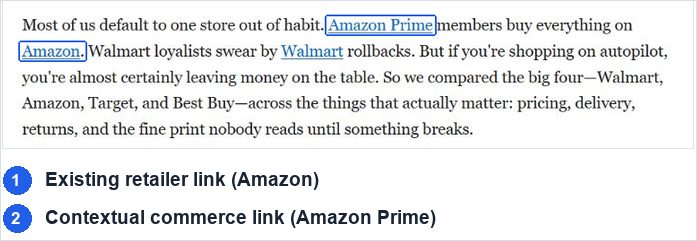
Illustrative ShopperWizz excerpt showing an existing retailer link and a contextual commerce link.
The two actions can be configured separately. Publishers can enable or disable link wrapping and contextual link creation, and block selected domains. If you already use affiliate links or have direct merchant agreements, review how the setup will handle those links before activating pages. Check the destination and make sure each link makes sense in context.
Shopnomix reports supported clicks, conversions and revenue. Those figures help you see which pages produce commerce activity. To judge whether the change added value, compare eligible pages against their existing performance and account for any changes to traffic, merchant mix or existing affiliate revenue.
Help Readers Compare Products Through On-Site AI
Sometimes the next step is another question.
A reader comparing carry-ons might ask which model fits an airline’s size limit. An on-site assistant can use the information configured for that experience to explain the relevant differences and, where supported, provide a product link.
In Shopnomix’s announced Brambles.ai partnership, Brambles provides the on-site conversational experience and Shopnomix provides the commerce infrastructure. Product sources, tracking, monetization and reporting depend on the integration. Before testing, decide which pages can use chat, what information it can draw from and who will review its answers and destinations.
Start by checking whether the experience answers the question well. Track product clicks where supported, then assess purchases and commission separately. The Shopnomix guide to answer-engine commerce explores how this experience can fit into publisher content.
Start With a Small Set of Pages
Choose a few pages with a clear reader need and an existing performance baseline. For Commerce Links, agree on which links and mentions are eligible, which destinations to exclude and how outcomes will be reported. For conversational commerce, start with a recurring product question and test the answers on mobile and desktop.
Review reader experience and earnings together before expanding. If you’re also evaluating sponsored placements, ask Shopnomix about the Performance Media programs for which your site may qualify.
Talk to Shopnomix about which pages and commerce opportunities make sense for your site.