
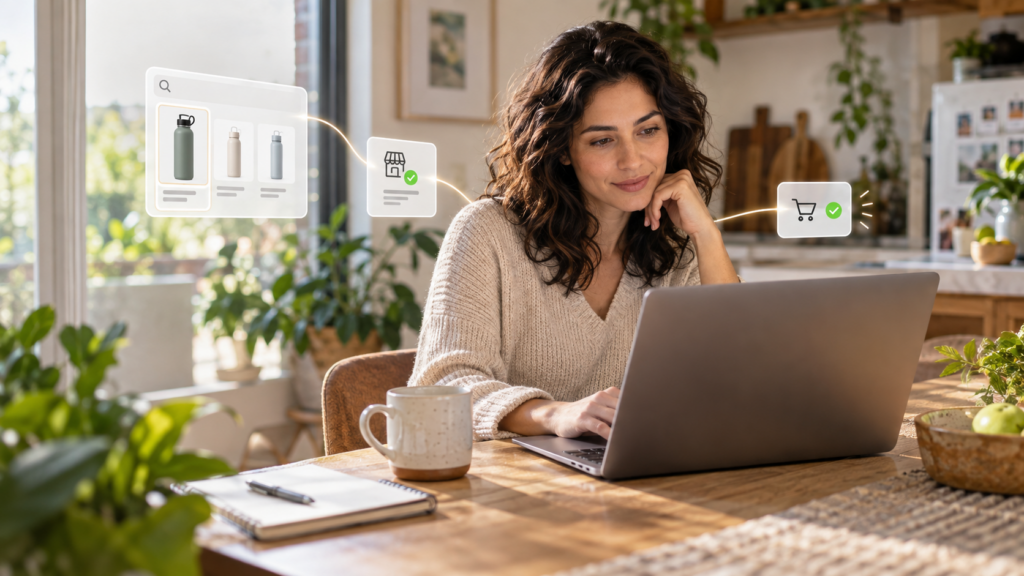
Retail media is no longer only competing for a place in the media plan. It is moving into the shopper’s decision process itself.
That shift is easiest to see in the new shopping assistants.
When an assistant can help a shopper plan a meal, compare a product, or build a cart, paid product placement is no longer simply adjacent to the experience. It becomes part of the answer a shopper receives.
The commercial question is no longer just whether an ad was served. It is whether the retailer, brand, and media system helped a customer move from an expressed need to a useful next step.
That raises the standard for performance commerce.
The Media Unit Is Becoming an Answer
For most of digital media, the basic unit of optimization has been an impression, a click, or a conversion. Those measures will remain useful, but they do not fully describe an experience in which a consumer begins with a question and is presented with a product, a rationale, and a route to purchase in one interface.
Kroger’s decision to include product-listing ads in its AI shopping assistant at launch is a concrete sign of that transition. The shopping interaction and the paid commercial opportunity were designed together rather than connected later. The same pattern is emerging across AI-shaped search and automated shopping experiences, where research-heavy referrals can arrive deeper in the product journey than traditional search traffic.
This does not turn every piece of commerce media into customer service. It does mean the media function is increasingly judged within a service-like moment. A poorly matched product, incomplete product detail, unsupported claim, or weak handoff can damage the experience at the point where intent is most explicit.
The old response would be to buy more visibility. The better response is to make visibility useful.
Product Context Becomes a Media Input
That requires a different relationship between commerce teams and media teams. Product feeds, availability, pricing rules, category language, reviews, claims, and destination logic are no longer only merchandising inputs. They influence whether an assistant or automated system can match a product to a question with enough confidence to make the result useful.
The practical shift is from campaign readiness to answer readiness.
A campaign can be ready when the creative is approved, the audience is selected, and the placement is booked. An answer-ready commerce system also needs product information that survives comparison, routing, and automated interpretation. It needs clarity about which products are appropriate for which use cases, what the customer should know before purchase, and where the experience should resolve.
That is an operating problem, not a copywriting exercise. The relevant information is often split among product, retail, media, analytics, legal, and customer-experience teams. If those groups only meet after a media issue appears, the business is treating the shopping interface as a distribution endpoint instead of a commercial decision surface.
Automation Makes the Handoff More Important
Automation intensifies the problem. Agentic buying tests, AI-led planning tools, and automated campaign systems can reduce manual work, but they also increase the number of decisions made between the original brief and the shopper’s final interaction.
That makes the handoff between media logic and commerce logic more important, not less. A system can optimize toward a campaign objective while still sending a shopper to a product page that does not resolve the question that prompted the interaction. It can report activity while masking whether the shopper received a useful match. It can expand reach while reducing the ability of a team to explain why a product was presented in a particular moment.
The response should not be to reject automation. It should be to establish the conditions under which automation can act.
Commerce leaders need explicit rules for approved product inputs, destination quality, product eligibility, and performance evidence. Media leaders need to understand which business questions are being delegated to the platform and which remain owned by the team. Analytics leaders need to distinguish a platform’s activity report from evidence that the service surface improved the customer’s route to purchase.
A retailer or marketplace can make those choices inside its own environment. Brands need enough shared operating discipline to assess whether participation is creating useful demand, capturing existing demand, or merely producing a more polished report.
Measurement Has to Follow the Experience
This is where retail media’s data debate becomes more urgent. Closed-loop signals can be valuable, but a closed loop is not automatically a complete explanation. The closer media gets to the point of decision, the easier it becomes to mistake a recorded transaction for evidence that the paid intervention changed the decision.
That is why teams need to connect three views of performance: the shopper question, the commercial response, and the final outcome.
The first asks what need or intent the experience was designed to address. The second asks whether the product, message, and destination were appropriate to that need. The third asks what happened after the interaction, including whether the result can be compared with another surface or another route to purchase.
None of these alone is sufficient. Together, they create a stronger basis for deciding where a retailer’s media product is genuinely improving commerce performance and where it is simply operating closer to the transaction.
The next retail media advantage will not belong to the team that reports the most signals. It will belong to the team that can connect those signals to a shopper experience worth repeating.
The Big So What
For CEOs
- Treat AI shopping and retail media as a customer-experience operating issue, not only a channel investment.
- Require a clear owner for the journey from question to product destination.
- Review retailer and platform dependence through the quality of the shopper handoff.
- Ask whether commercial reporting can distinguish service value from captured demand.
For CMOs
- Make product context and destination quality part of media planning.
- Design commerce creative around the shopper question the experience is meant to resolve.
- Align campaign objectives with the product information available at the moment of decision.
- Test whether paid placement improves the route to purchase, not merely the volume of reported activity.
For CROs
- Map where assistants, marketplaces, and retail media systems intervene between intent and checkout.
- Set standards for product eligibility, product claims, and destination quality across commercial partners.
- Build reporting that connects shopper intent, commercial response, and revenue outcome.
- Escalate cases where an automated surface can report performance without showing the quality of the handoff.
References
- Search Engine Land: Shopify: AI referrals up 197%, but organic search still leads traffic
- Modern Retail: Kroger’s AI shopping assistant has ads at launch
- Marketing Dive: ANA cautions marketers against overreliance on retail media data
- Digiday: Butler/Till extends agentic media buying tests into audio with iHeartMedia
- AdExchanger: IAB’s New Advice On How To Measure AI Search Visibility