
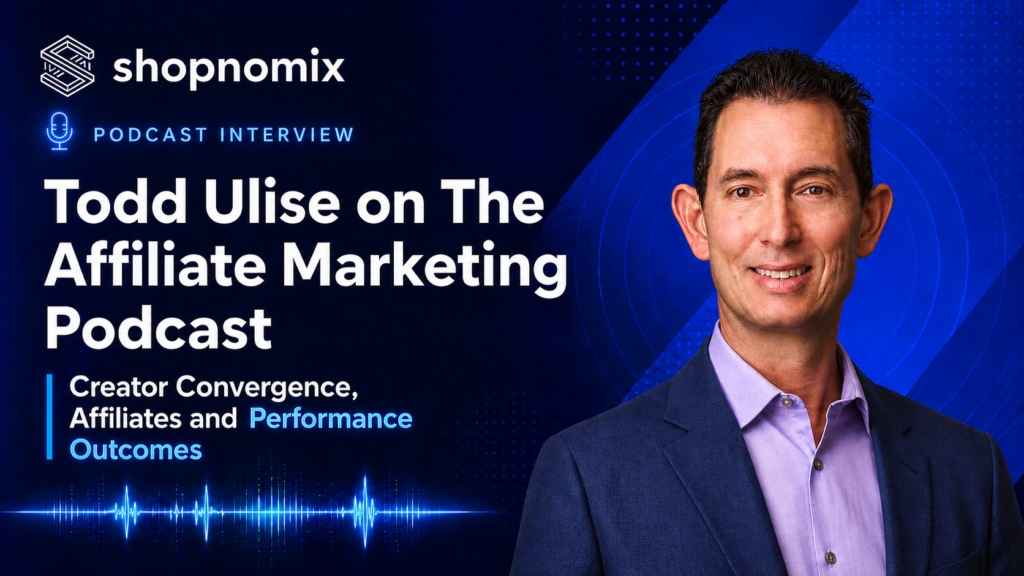
Todd Ulise joined Lee-Ann Johnstone, host of The Affiliate Marketing Podcast, for a conversation about what happens when affiliate programs, creator partnerships, and performance economics begin to converge.
The discussion moves across creator-led influence, unified measurement, brand safety, intent signals, outcome-based pricing, and the need for brands to manage different partner types without forcing them into the same workflow.
Listen to the Conversation
Prefer audio? Listen on Apple Podcasts or Spotify.
Three Key Takeaways
1. Creators and Affiliates Need Shared Measurement, Not Identical Workflows
Ulise explains that traditional affiliate publishers and creators can belong inside the same broader program, but they should not be managed as if they play the same role in the customer journey. Affiliates are often optimized around conversion capture, while creators may shape demand earlier through trust, attention, and influence.
For brands, the opportunity is to build one source of truth for value while still giving each partner type the right economic model. That means measuring verified transaction outcomes, contribution quality, incrementality, and conversion efficiency without forcing every partner into the same payout or timeline.
2. The Biggest Barrier Is Organizational Alignment
The conversation repeatedly returns to ownership, budgets, and incentives. Ulise argues that the challenge is not primarily whether technology can track more complex partner journeys. The larger problem is that affiliate, creator, media, and commerce teams are often compensated and evaluated differently.
That makes C-level alignment essential. When leadership defines a unified outcome framework, teams can stop fighting over attribution and start managing the full media mix around customer value, performance economics, and long-term market share.
3. Intent Is Moving Earlier and Becoming More Distributed
Ulise describes a market where commercial intent no longer begins with a traditional keyword search. It shows up in conversational AI, creator environments, browser experiences, review content, commerce surfaces, and other distributed touchpoints before the user reaches a checkout page.
For affiliate and ecommerce leaders, that changes what performance means. Clicks without context are a weak signal. The stronger opportunity is to understand where intent is forming, capture it earlier, and connect those signals to verified outcomes across the full commerce journey.
Why It Matters for Brands
The practical thread running through the episode is that affiliate commerce is becoming a broader performance-based media system. Brands need cleaner measurement, clearer partner economics, stronger creator strategies, and leadership alignment that treats creators, publishers, search, AI surfaces, and commerce infrastructure as connected parts of the same revenue system.
The next phase of affiliate growth will not be defined by last-click credit alone. It will be defined by how well brands connect trusted influence, distributed intent, operational transparency, and outcome-based pricing into programs that can scale without losing accountability.
Full Transcript
Transcript lightly edited for clarity, readability, and speaker attribution.
Speakers: Lee-Ann Johnstone, host of The Affiliate Marketing Podcast; Todd Ulise, Chief Revenue Officer of Nomix Group.
Todd Ulise:
So, really, the better way to think about this is that different partner types can live inside the same program, but they shouldn’t be forced into the same economic workflow.
Lee-Ann Johnstone:
You’re listening to The Affiliate Marketing Podcast, powered by Affiverse, the ultimate destination for affiliate program news, insights, growth opportunities, partnerships, and affiliate program strategy.
Lee-Ann Johnstone:
If you’ve been following this show, you’ll know we’ve been deep in conversation about what happens when affiliate programs start colliding with the creator economy. We explored it with the team at Levanta in a recent episode, and if you missed that, you can go back on site and give it a listen, because today’s conversation picks up exactly where that thread left off.
Lee-Ann Johnstone:
My guest today has been in the trenches of performance marketing for over two decades, scaling programs, building partnerships, and now sitting in the chief revenue officer’s seat at Nomix Group, overseeing a portfolio of platforms that includes Shopnomix and other Nomix Group businesses.
Lee-Ann Johnstone:
Before this, he spent 14 years as SVP at ad.net, helping drive that business into eight-figure revenue. Across his career, he’s been responsible for growing programs to over $150 million in annual revenue.
Lee-Ann Johnstone:
The conversation we’re about to have is one I think every affiliate manager and every brand running an affiliate program needs to hear, because it’s about what actually happens when you stop treating creators and traditional affiliates as separate budget lines and start measuring both against the same verified transaction outcomes.
Lee-Ann Johnstone:
Welcome back to this week’s episode of The Affiliate Marketing Podcast with me, your host, Lee-Ann Johnstone. I met this gentleman finally in person in Vegas earlier this year, and now here he is on our mic. It is Todd Ulise. He’s the Chief Revenue Officer of Nomix Group, which is doing some amazing things, and we’re going to get all into that in a minute. Todd, welcome onto the show. It is a pleasure to have you here. It’s a long time coming, and I’m super excited to get started.
Todd Ulise:
Thank you so much, Lee-Ann. I’m really excited to be here. It’s definitely a long time coming, and I’m happy to have this conversation today.
Lee-Ann Johnstone:
To get us started, I think it would probably be best for me to ask you to introduce yourself and say hello to my audience. You are, I’m going to say, an OG. You’ve been in the industry for decades, and not to make you sound old, but you’ve had a very long, illustrious career in affiliate marketing.
Lee-Ann Johnstone:
Maybe give us a little bit of that background first, and then we’re going to pick your brains about the convergence of affiliate and creator.
Todd Ulise:
I’ve been in digital for 26 years. After university, I packed up my car with no job and no money and moved from Tucson, Arizona, to Seattle, Washington, so probably the polar opposite in terms of weather.
Todd Ulise:
I worked at Amazon for a little bit, then worked for a digital startup that was the hot new internet company in Seattle one week, and then the venture capitalists pulled out a week later. A typical startup story from when the internet was hot.
Todd Ulise:
I came back to Los Angeles and joined a company called Traffic Marketplace. We were an ad network before the “ad network” name really came to the fore. We brought the pop-under ad unit to the marketplace and built a big banner display distribution business. I ran the publishing team and found a pain point: publishers were hurting for revenue, and there was an opportunity to build incremental revenue solutions for them.
Todd Ulise:
We had tremendous growth and ended up selling the company to Vivendi Universal. We operated that for a number of years, and then Vivendi was looking to divest the asset. We were in conversations with a company called Overture at the time to take my display distribution, which was one of the biggest ad networks in the world, and put search results into it.
Todd Ulise:
Back in 2002 or 2003, Yahoo came in and bought Overture, and the deal fell off the table. The company divested.
Todd Ulise:
About a year later, a friend of mine who was a comedy producer reached out to me because I knew digital marketing and affiliate marketing. He said, “Hey, do my digital marketing for me.” He ended up becoming one of the biggest comedy producers in the world. Before I knew it, I was doing marketing for a guy named Dane Cook, who had the biggest-selling comedy release since Jimmy Carter was president in the States.
Todd Ulise:
We were doing things like social promotions, which at the time meant Myspace, and working with bloggers on content, which was basically influencers before we used that term. That was around 2004. I found a second pain point, which was that comedy marketing was underserved, and built a business around that. We built a portfolio of comedy websites and sold that entity in 2011.
Todd Ulise:
Flash forward, I started with a company called ad.net and built the incremental search ecosystem, because search was monopolistic with Google in 2011. And who did that hurt? It hurt brands. That was another pain point.
Todd Ulise:
We ended up selling a majority portion of that business to a private equity firm in 2021.
Todd Ulise:
So, the history of my career is: find a problem, solve the problem, scale the business, and sell it. I’ve done that across three entities over 26 years.
Todd Ulise:
I came aboard Nomix Group back in January as Chief Revenue Officer. I saw what they were doing and liked where the business was growing. Talking again about finding a problem, the problem Nomix Group is solving is fragmentation. The media ecosystem is more fragmented than ever, and we address that through our commerce-everywhere solutions, especially with the conversation today around creators and taking affiliate marketing into the creator space.
Todd Ulise:
So that’s my 26-year career in a nutshell.
Lee-Ann Johnstone:
It’s also a massive history lesson for anybody listening, because a lot of those companies were like Google when I was coming up the ranks. You got in early, right as the door was opening, and you saw how those companies were built, exited, sold, and how they solved problems.
Lee-Ann Johnstone:
It’s your career, but it’s also the history of how this industry has evolved. That’s why I love having people like you on the podcast, because all of this knowledge isn’t written down in history books. If you’re new to the industry, you’re really lucky to be listening to this podcast today, because Todd has a bird’s-eye view of what’s happened over the last 20-plus years in the industry and why it is the way it is today.
Lee-Ann Johnstone:
I’m super thrilled to have you here and thank you very much for being here and sharing your time with us. It’s invaluable.
Lee-Ann Johnstone:
Let’s talk about where we are now. Like you said, your career has been about spotting problems and seeing fragmentation. Where does it break down right now? What’s happening with the convergence of the affiliate and creator sectors?
Lee-Ann Johnstone:
There was news that came out recently that Target has stopped its creator program as part of its affiliate program, and it’s looking at working with nano-influencers instead because it has seen consumers resonate more with content creators who aren’t necessarily ambassadors.
Lee-Ann Johnstone:
Where do you see things breaking down right now, and what is Nomix Group trying to solve?
Todd Ulise:
Every brand wants to reach consumers in the most efficient manner possible, and every publisher wants to maximize revenue and eyeballs. The mousetraps may change year over year, but the performance economics are always similar.
Todd Ulise:
Traditionally, it breaks down when a brand tries to force creators and affiliates into the same operating logic without understanding that each plays a different role in the journey.
Todd Ulise:
Traditional affiliate publishers are optimized around conversion capture, harvesting demand, and lower-funnel activity. Creators often get into higher-funnel engagement. The challenge we face is that they’re often briefed in the same way and judged on the same timeline. That’s where the friction starts, because creators and affiliate marketers are different pieces of the ecosystem.
Todd Ulise:
The better way to think about it is that different partner types can live inside the same program, but they shouldn’t be forced into the same economic workflow.
Todd Ulise:
People want a unified measurement framework, but they don’t always want to look at partner management in a unified way. You can’t really have it both ways.
Todd Ulise:
We need to rethink the structure so that it reflects how consumers actually move in the real world across creators, AI surfaces, search environments, and other discovery points. It’s not one clean, linear path.
Lee-Ann Johnstone:
It’s a big problem right now because of the fragmentation across channels, across partner types, and now even across how people enter the internet. Nobody goes to Google first anymore. That brand awareness or consideration funnel no longer exists in the same way because of the advent of GEO and AI-driven search.
Lee-Ann Johnstone:
We had Cullen on the podcast a couple of months back, and we were talking specifically about that. That was six months ago already, and now it’s even more prevalent.
Lee-Ann Johnstone:
How do we solve the budget-line problem? As a performance marketer, you’re paying on performance, but you could be paying on performance across multiple channels and traffic sources. How do you create certain influencer budgets, affiliate performance budgets, and reconcile all of this now?
Todd Ulise:
Even compared to six months ago, the pace has accelerated significantly. The consumer journey is fragmented, so what really has to change is structural: ownership. Where does the money flow?
Todd Ulise:
If creators are poured into one budget owner and affiliates into another, both teams are measured against different success metrics. You’re never really comparing them on the same basis — apples to apples.
Todd Ulise:
It’s the age-old argument in internet marketing: optimizing to channels and attribution. I like to call it “who stole my cookies?” for lack of a better term, because people are fighting over attribution.
Todd Ulise:
The shift has to move into an outcome framework. Every creator doesn’t need to be paid exactly like a lower-funnel affiliate, but the business needs one source of truth for what value looks like.
Todd Ulise:
Both sides need to be reconciled against verified transaction outcomes, contribution quality, incrementality, and conversion efficiency.
Todd Ulise:
Then the conversation changes. You look at it as a holistic marketing program instead of channel managers fighting against each other. Then you can decide what makes sense: fixed fees, CPA, a hybrid model. But until the measurement model is unified, the problem never really gets solved.
Todd Ulise:
I’m anxious to see how Target’s approach plays out. Brands often put different strategies together, and we’ll see the efficacy. Then, as an industry — marketers, platforms, and partners — we can pivot, change, and look at things holistically. I always applaud brands for testing things out and trying new things in the best interest of the overall brand, rather than looking at things channel by channel.
Lee-Ann Johnstone:
Do you think technology is going to catch up now? Most affiliate networks still run on last-click or server-to-server tracking. They commission and offer attribution in the same way.
Lee-Ann Johnstone:
Is there a need now for technology suppliers to catch up with how consumers are changing their purchasing behavior online, and to allow affiliates, creators, and all of these different partners in the affiliate mix to have the freedom to be run differently but still within the same program?
Lee-Ann Johnstone:
Because we can’t really do that right now. It is possible, but it’s not measured equally on each side, as you said.
Todd Ulise:
I’ve been told many times in my career that I think differently than most people, and you’ll probably start to see that the more we talk.
Todd Ulise:
I’ll say this first: it’s never a technology problem. It’s always a people problem.
Todd Ulise:
Technology can solve whatever decision we decide to make as an industry. The larger issue is the compensation structure at many companies. The affiliate team is compensated one way. The creator team is compensated another way. When you create a compensation structure where one channel might not produce bottom-line results in the same way as another channel, people tend to start infighting within organizations.
Todd Ulise:
Once we agree and align, that needs to come from the C-level down, not from the bottom up.
Todd Ulise:
It’s really a people issue more than a technology issue. We need to align on a unified measurement system and say, “We know that top-of-funnel creator engagement might lead to actions at the bottom of the funnel, whether on a review website, a coupon website, or two or three months down the line when an offer becomes available.”
Todd Ulise:
I think differently than most. I think it’s more of a people problem than a technology problem. People need to align on unified measurement and what that looks like in order to have transformational change and value each piece of the pie.
Todd Ulise:
When you go to a soccer stadium or a baseball stadium, you see signage in the outfield or behind the goal. Are you going to buy immediately? Maybe not. But does it create an impression? Does it make you think about that product later when you’re ready to make a purchase decision? Absolutely.
Todd Ulise:
It’s about understanding where it happens in the mind of the consumer. It’s very hard to codify because you have channel managers fighting against each other over what they’re measuring. It goes back to what I call “who stole my cookies?”
Lee-Ann Johnstone:
I deal with clients like that all the time. It’s, “We can’t do this because it doesn’t impact our budget,” but then we lose sight of how it benefits the business as a whole.
Lee-Ann Johnstone:
It doesn’t matter whose budget it is. Are you actually getting the customer? It doesn’t matter whether they come through PPC, affiliate, or wherever. Are you actually getting the customer?
Lee-Ann Johnstone:
You said something really valuable: it needs to come from the CEO level. However, I still encounter a lot of brands with CEOs who don’t understand what performance marketing is or how it should be working for their business.
Lee-Ann Johnstone:
There’s an education piece that needs to happen, which is exactly why we’ve got this podcast. I’ve never had anybody say it so clearly before, so thank you for doing that.
Lee-Ann Johnstone:
There’s this trust crisis and transparency tightrope that we’re constantly navigating. How do you help both sides navigate this visibility issue? It’s siloed, right? How do you approach that when you’re working with big clients that are spending a lot of money with you?
Todd Ulise:
I want to step back and say transparency doesn’t equal brand safety.
Todd Ulise:
Brands want brand safety. They’re often less concerned about transparency. For example, you can have great transparency, but things might not necessarily be brand-safe because of content reviews, whether real or generated. That has always been one of the challenges of the internet. It is a challenge now, and it will continue to be a challenge.
Todd Ulise:
Brands should be asking harder questions. The problem is there has always been leakage and too much low-quality inventory arbitrage. Bad actors have made parts of the ecosystem untrustworthy.
Todd Ulise:
When email marketers realized in 2000 or 2003 that they could make more money sending 50 emails a day instead of one, guess what happened? This industry has not always been the best at self-regulation. Ultimately, we’ve gotten better, with things like CAN-SPAM and disclosure rules, and that is critically important.
Todd Ulise:
The answer is that most publishers can’t expose everything. The best way to handle transparency is to ask what brands actually care about. How do you look at it? What criteria do you have?
Todd Ulise:
Any platform or affiliate should build systems that reflect what brands need. The reality is that you can’t confuse transparency with brand safety or surveillance.
Todd Ulise:
Brand safety is the most important thing. Major brands should have clear indicators. On the conversion side, they need to validate quality and compliance. Publishers need to have enough protection to service the brands they work with.
Todd Ulise:
The middle ground is to have a conversation. Most people don’t want to have that conversation. Sit down and ask: how are you determining brand safety? What are you looking at? What are the key criteria? Are you looking at multiple clicks? Are you looking at transactions? What are you actually measuring?
Todd Ulise:
Then turn that into a repeatable measurement structure, with full disclosure on what you’re doing and how you’re doing it.
Todd Ulise:
When I say transparency, I mean operational transparency. What are you doing? How are you doing it? Have an open conversation about that. That’s more important than using transparency as a vague term. It helps bridge the brand-safety gap while still protecting publishers’ intellectual property and secret sauce.
Lee-Ann Johnstone:
I totally agree.
Lee-Ann Johnstone:
I want to dig into some of the numbers, because you see a lot of data. Shopnomix processes around three billion monthly queries, which is a lot of data. What’s shifting in consumer intent signals right now, and what does that tell you about where the industry is headed?
Lee-Ann Johnstone:
A lot of affiliate managers and brand managers, especially in ecommerce, are trying to navigate where to segment their portfolio now. Do they spend money in AEO, GEO, coupon sites? Where are you seeing consumer intent change across all of this data?
Todd Ulise:
Intent is getting expressed a lot earlier, in more places, and with more context.
Todd Ulise:
Traditional search meant people would go to a search results page and search for something. That has been completely upended by AI. A lot of commercial intent is now in less obvious places.
Todd Ulise:
The same intent is showing up in conversational AI. How often do you talk to your AI agent on a daily basis? Do you see results included in there? Absolutely.
Todd Ulise:
I’m very excited about the creator-led economy. Creators are the new publishers. I’ve been saying that for a long time, but now, with things like live shopping within Meta, creators are becoming more of a trusted source.
Todd Ulise:
I wrote an article probably 11 or 12 years ago saying I wanted to rename search marketing as intent-driven marketing. When you look at intent, it’s really any expressed belief, feeling, or action toward doing something.
Todd Ulise:
Creators are leading the formation of intent because you trust those creators. They create a trusted, intent-driven environment.
Todd Ulise:
In addition to pre-search environments, we’re seeing integration within browsers and distributed touchpoints. The nature of going to search first is gone. Intent is being extrapolated earlier on, and the companies that can capture that intent are the ones that will win.
Todd Ulise:
The signal is still there, but you have to be able to act on it before the user does a physical search or gets to a checkout page where the bottom of the funnel gets the credit.
Todd Ulise:
The other thing that’s changing is specificity. AI and conversational commerce don’t work like old keyword search, and I actually think that’s better. It allows people to get what they want sooner. The signal is richer, and people are asking for product recommendations with constraints, context, and urgency built in.
Todd Ulise:
The future channel is less about fighting over last click and more about understanding how to capture intent across a distributed journey. That’s what Nomix Group is leaning into with performance economics and commerce everywhere: helping brands reach consumers across a distributed consumer journey.
Lee-Ann Johnstone:
Just quickly, because some people won’t have heard of Nomix Group, give us the full composition of what Nomix Group is. I know some people know Shopnomix, but they won’t know all the other parts of Nomix Group.
Todd Ulise:
Nomix Group is a holding company. It started out of Shopnomix about three years ago, very focused on the affiliate commerce space. The company has had tremendous growth, both organically and through acquisitions.
Todd Ulise:
Nomix Group is really a holding company of assets, including Shopnomix, which works with 400,000 creators, and FanNomix, our AI-driven content production studio, which allows us to build and deploy creative in real time. We use creative velocity as a core competency to help brands scale at a fraction of the cost of traditional production companies.
Todd Ulise:
Nomix Group solves multiple problems: fragmentation through commerce everywhere, creative performance economics, and distribution infrastructure at scale for brands. Most companies can only handle one of those three pieces. Nomix Group has the end-to-end solution through its portfolio of products, services, and companies.
Lee-Ann Johnstone:
It sounds complex, but it’s also really clever because it helps brands touch the consumer in multiple ways and at scale. That’s what we need right now.
Todd Ulise:
In any outcomes-based economy, Cullen stated this on a previous podcast, but the increase of inventory, especially with AI, is shifting us more toward an outcomes-based economy.
Todd Ulise:
How we determine that outcome is what we were talking about earlier. Is the creator piece more mid-funnel? How do you measure that once the customer eventually purchases? Aligning on a unified measurement model to show those outcomes is critical.
Todd Ulise:
Having that C-level conversation is tantamount and critically important.
Lee-Ann Johnstone:
We’re also getting to a point in the industry where the data leads us, and the data we have is actually quite strong. Before, it wasn’t that it was mixed, but it wasn’t clean. It wasn’t 100% clean.
Lee-Ann Johnstone:
Now we’ve reached a point where we can measure everything right back to the first impression and the first click that happens in a customer’s lifecycle journey. I’m quite excited about that, because it allows us to change the commercial aspects.
Lee-Ann Johnstone:
I know you’ve argued that CPC giving way to CPA is the inevitable next shift. Talk us through that thought process, and how Shopnomix shoulders the performance risk with the clients you work with.
Todd Ulise:
It’s just math at this stage.
Todd Ulise:
After 26 years, I look at these things as financial systems. Internet marketing is really made up of CPM, CPC, or CPA. Granted, within CPA there are probably 50,000 variations: CPS, rev share, fees with a baseline. But those are the economic models.
Todd Ulise:
Every publisher wants risk mitigation. Every advertiser wants performance economics. The market is shifting that way. It’s not completely moving there overnight, but it is moving.
Todd Ulise:
A lot of teams still like CPCs because of familiarity. It’s Google. They’re used to it, and it’s the easiest model to slide into an existing media structure.
Todd Ulise:
Think about how media teams are structured. You have a search and social team, an affiliate team, a video and display team. Those are all often based on pricing metrics. But the more precise label is: what action do you want to have taken place, and how do you want to pay for that action?
Todd Ulise:
I still answer the question in terms of CPA because that’s where we see the broader market shift. If you build on a CPC with a CPA backstop or guarantee, it doesn’t really matter. It’s just math. It puts the onus on platforms to have best-of-breed infrastructure and optimize to performance.
Todd Ulise:
The point is that we’re moving toward outcome-based pricing models and verified transactions. The internet has all of these acronyms that keep people out: CPA, CPS, rev share, and so on. They make us sound intelligent, but really we’re talking about outcome-based pricing.
Todd Ulise:
Whether it’s CPA, CPS, rev share, or another model, there has to be some form of outcome. I’m very optimistic that even CPMs are moving more toward outcome-based pricing, which is really the mantra of affiliate-based marketing anyway. You want to achieve a specific goal, and you want payment tied to that goal.
Todd Ulise:
The key thing I’ve learned in 26 years is not to force everything overnight. The right approach is crawl, walk, run.
Todd Ulise:
Start with what you’re measuring. Test it. Validate quality. Prove the economics. Then expand.
Todd Ulise:
Shopnomix predominantly performs on CPA. Around 90 to 95% of the business is CPA-driven. That model works because performance risk is understood up front, and onboarding is data-driven.
Todd Ulise:
The channel doesn’t need to be about slogans. It’s about operating with confidence, having a path to get there, and allowing brands to pay for results — performance-based results.
Lee-Ann Johnstone:
That’s actually a really good blueprint. If you want a well-run unified affiliate program that brings content creators, traditional publishers, and everyone else together, follow those four steps. That’s the best place to start. From there, you’ll get the answers you need to improve what you’ve already got.
Todd Ulise:
The challenge traditionally is that there are different payouts across these channels. It comes down to an economic-based model.
Todd Ulise:
We see affiliate payouts getting stronger because the value of affiliate quality has actually increased.
Todd Ulise:
I want to rename affiliate marketing as performance-based media. The notion of “affiliate” has connotations, whether positive or negative. I’ll let your audience debate that. But really, affiliate marketing is performance-based marketing.
Todd Ulise:
Then you can uplevel affiliate marketing and expand it. The lines are never super clear. There is overlap between affiliate, creators, influencers, and other partner types.
Todd Ulise:
Once payouts get level-set, you can look at it more fairly. If it’s a coupon site and you’re discounting by 5%, maybe you adjust the payout accordingly. There is value in every piece of media. It’s just about quantifying that value and aligning key stakeholders from the C-level.
Todd Ulise:
That allows brands to build market share and pay what those users are worth, whether you look at LTV, CAC, or other metrics.
Todd Ulise:
It takes a visionary CEO or CMO at a brand to say, “Let’s look at the entire media mix. Let’s build market share for our brand, and here’s how we’re going to do it.”
Todd Ulise:
I always instruct teams to perform 20% better so they have 20% discretionary room to invest in new channels. You don’t know what you don’t know. Test everything and see what ultimately performs and scales the business.
Lee-Ann Johnstone:
I think sometimes we’re too scared to test. We get into a rut. It’s, “We’ve always done it this way.” Testing something new can feel like extra work.
Lee-Ann Johnstone:
But what you said is true: it’s a people problem. The change starts with us. It doesn’t start with telling somebody else about it. It starts with you.
Lee-Ann Johnstone:
Incrementally test something. Try something a little bit different. Do one thing a month. It doesn’t have to be everything all at once, because that’s overwhelming and you won’t get the right data results.
Lee-Ann Johnstone:
Okay, we’ve got to the fun rapid-fire round, where I throw my questions at you and you answer them.
Lee-Ann Johnstone:
First one: creator or traditional affiliate publisher? Pick one for the next five years.
Todd Ulise:
Creator, significantly — but only if creators get measured like performance and not protected like a vanity channel.
Todd Ulise:
There is a significant increase in creators, and that’s where the dollars are shifting. The amount of money spent on creators has not yet caught up, in terms of the broader media mix and marketing dollars, to the amount of money being pumped into the creator side. So, creators for sure.
Lee-Ann Johnstone:
The metric that performance marketers are most wrong about right now?
Todd Ulise:
Clicks without context.
Todd Ulise:
Intent is the value signal, and how you extrapolate intent earlier in the funnel is the most important thing.
Lee-Ann Johnstone:
Biggest mistake brands make when they first try to integrate creators into an affiliate program?
Todd Ulise:
They try to literally copy affiliate goals without deciding how creators actually influence demand. You have to look at creator as a unique channel.
Lee-Ann Johnstone:
Yes, and they try to treat creators exactly the same way they would treat an affiliate, when they are completely different personas.
Lee-Ann Johnstone:
CPA or revenue share: pipe dream or rise of the inevitable?
Todd Ulise:
Rise of the inevitable. Completely the rise of the inevitable.
Lee-Ann Johnstone:
Lastly, one piece of advice you’d give your 25-year-old self starting out in performance marketing today?
Todd Ulise:
Don’t confuse volume with value. Learn the economics underneath the channel early on, and understand why every investment is being made.
Lee-Ann Johnstone:
If somebody walks up to you at a conference, what’s the best pickup line they could use?
Todd Ulise:
Want to see some data?
Lee-Ann Johnstone:
You would have to be in the industry for 26 years to pull that line.
Todd Ulise:
My response would usually be: how clean is your data?
Lee-Ann Johnstone:
Where does it come from?
Lee-Ann Johnstone:
All right, Todd, listen, it’s been an absolute pleasure to have you on the podcast this week. Thank you so much for sharing your insights on what’s happening in the performance marketing economy and the convergence of creator and affiliate working together.
Lee-Ann Johnstone:
Hopefully we get together and work to help solve the people problem and educate everybody around us to think about affiliates the way that you do, because I think the world would be a better place if everybody did it.
Todd Ulise:
Thank you. I really appreciate the time, and I’m always happy to support and be involved as much as I can in the community.
Lee-Ann Johnstone:
Until next week, everybody, we will say goodbye and thank you very much. This is The Affiliate Marketing Podcast. We look forward to seeing you again soon.